
Printer Friendly (PDF)
Last week we used the Pump Affinity Laws to determine what size the impeller would be trimmed to in an oversized pump. Reducing the speed of the pump has the same effect on the flow and head as trimming the impeller.
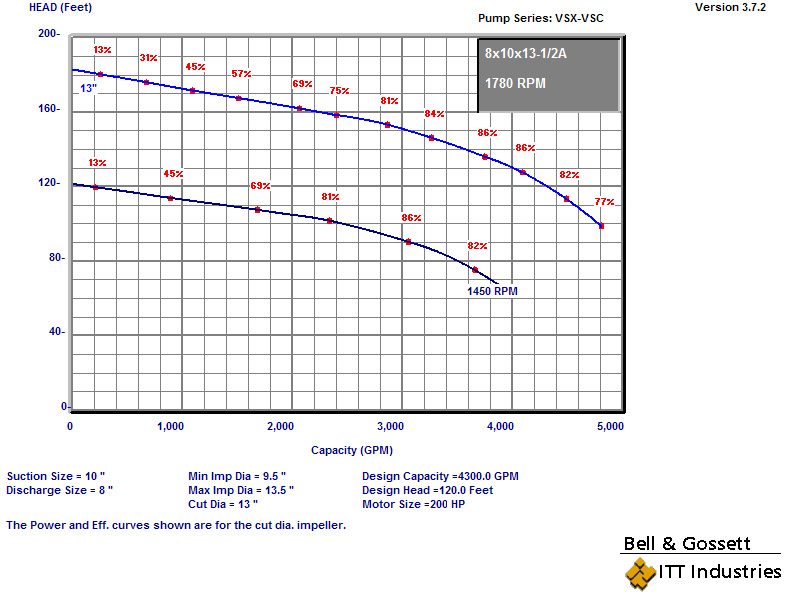
Let’s look at the example again. The engineer specified a Xylem Bell and Gossett VSX- VSC double suction pump in a closed chilled water system. The capacity is 3500 GPM at 140 ft head. The pump selected is shown below.
The balancing contractor reads the pump out after a proportional balance, and finds the operation point to be 4300 GPM at 120 ft. This means the pump is oversized.
As we discovered last week, the impeller could be trimmed to 10.75” to correct the problem. If this pump is operating on a variable speed drive, the speed could be reduced to design flow rate. What speed would we set as the maximum? To determine the correct speed, use the pump affinity law.
The design RPM on the curve is 1780. Check the nameplate of the motor to verify the actual speed of the motor. Each motor manufacturer may have a slightly different speed and usually it does not make much difference, but it is worth checking. If it is different, you can call your local B&G representative for a curve at the specific RPM of the motor. Let’s assume the motor nameplate is 1780 RPM.
Just solve the problem. (GPM1/GPM2) = (RPM1/RPM2) = (Hertz1/Hertz2)
So GPM1 is 3500; GPM2 is 4300; RPM1 is unknown; RPM2 is 1780.
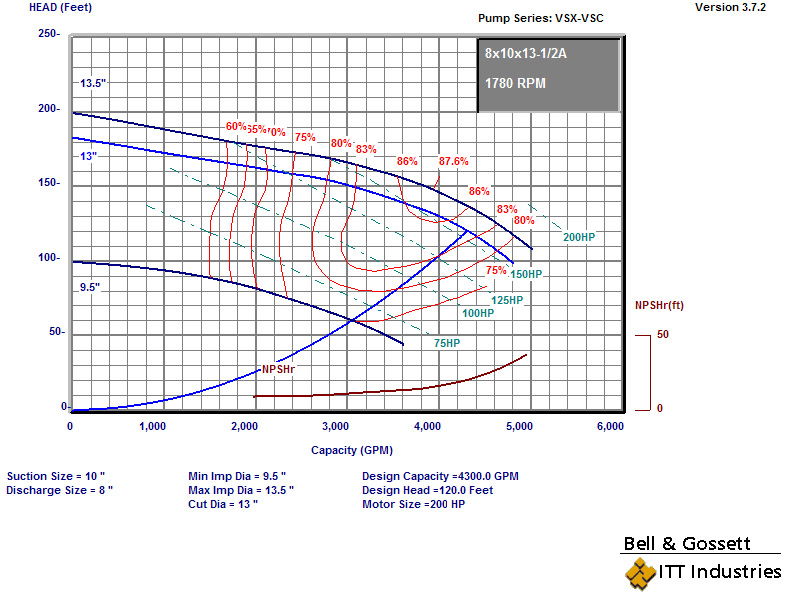
The answer is 1448 RPM or about 1450 RPM. Since hertz and speed are directly proportional, the 1450 RPM speed will result from dropping the drive to about 50 hertz. The resulting curve looks like this:
Click here to download the electronic System Syzer.