
Printer Friendly (PDF)
Determining the Pressure Drop
The purpose of the domestic water recirculation system is to deliver hot water near a fixture during times when there is no draw. If someone is using hot water in the next room or apartment or process; the hot water is near enough to your fixture, so the hot water is delivered in seconds, not minutes.
For this reason, the flow of water in a recirculation system is really needed when there is no demand in the system. The flow rate required in the recirculation system was determined – in the last couple of articles – to be a relatively low GPM. The pressure drop of the small flow rate, when there is no load, can be calculated similar to a closed hydronic system. Ignore the elevation, and size the return pipe for a reasonable velocity and pressure drop. Determine the pressure drop of the longest run or zone pipe and add any equipment pressure drops at the recirculation flow rate. In a later article, I’ll examine problems which may occur when there is load in the circuit. The mains are ignored, since the pressure drop in this larger pipe is negligible.
Last week our example ended up with 8 GPM of flow rate. The calculations might look similar to this:
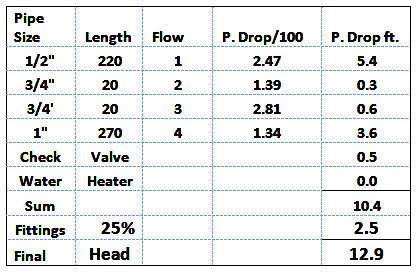
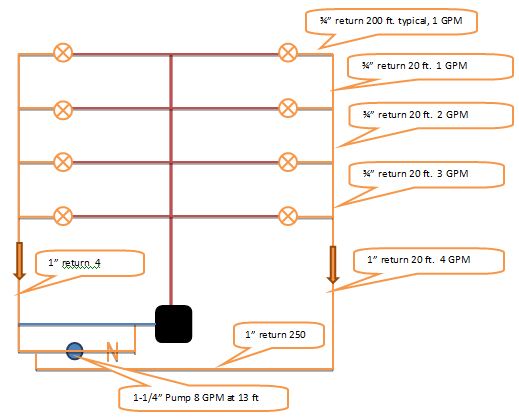
So, our pump would be selected for 8 GPM at 13 feet. We would select a B&G model PL-30B lead free bronze body pump with 1-1/4” flanges using a 1/12 HP, 115/60/1. We would also suggest the specification of the B&G CB-1/2LF lead free circuit setters for balance valves.
Next week we will look at high rise applications and the complexity of pressure reducing valves in the system.