Printer Friendly (PDF)
“Dual Temperature Systems and Mixing Valves”
“Performance Conditions of a Mixing Valve”
Last week, the R L Deppmann Monday Morning Minute article examined the addition of a mixing valve. Today we will examine the re-circulation system with dual temperature requirements and answer questions about the term “Performance Conditions.” For the purposes of this example, we will use a Lawler 805 Master Mixing Valve. You can refer to any manufacturer’s information for your particular system.
DUAL TEMPERATURE SYSTEMS:
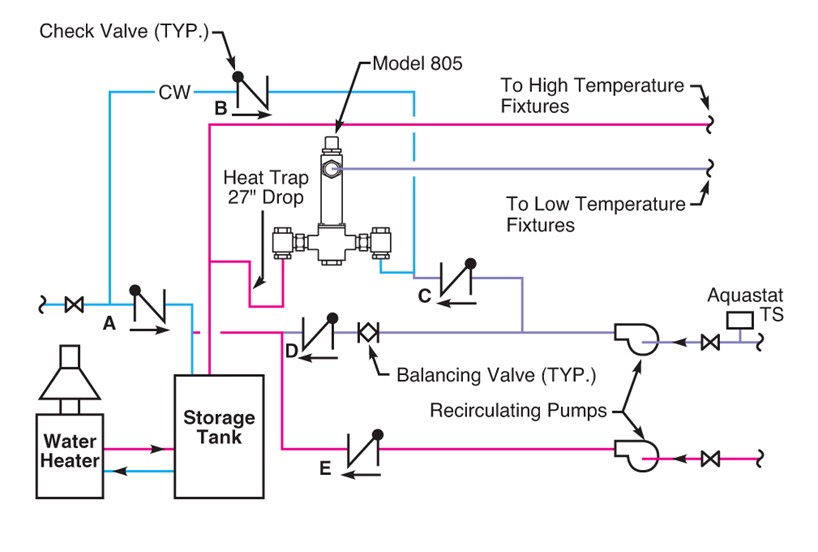
In the literature for the LAWLER 805 MASTER CONTROLLER shown below, there is a diagram showing the piping when you have a design using dual temperatures. In this operation, Lawler suggests a re-circulating pump from both the low temperature and high temperature system. As we mentioned last week, R. L. Deppmann recommends the use of a balance valve on the discharge of each pump to read and set the total flow rate from the system.
 PERFORMANCE CONDITIONS:
Imagine you are riding a 5-speed bicycle up an incline and you have set the gear for the incline and effort. You pedal away and work harder if the incline increases a bit and ease off if the incline drops a bit. You are able to maintain the same speed. But now the incline suddenly rises significantly and a strong wind hits your face. To maintain speed, you must change gears.
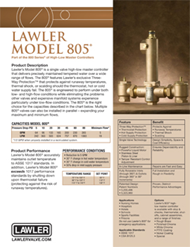
The Lawler performance conditions are similar. The mixing valve is designed to maintain temperature, once it is adjusted, after installation. Just like the bicycle example, the valve will operate fine and maintain temperature as loads change. If there is a significant change from the inlet conditions when the valve was adjusted, the temperature will not remain steady. These significant changes for the Master Controller model 805, shown here, are: a 30°F change in hot or cold water temperatures, a 50% reduction in hot or cold water inlet pressure, or a flow rate below 5 GPM. If any of these conditions occur, the valve may not be able to maintain the set temperature and a manual re-adjustment of the valve may be necessary.